




Zilliz Cloud BYOC Now Available Across AWS, GCP, and Azure
Today, we're announcing the general availability of Zilliz Cloud BYOC (Bring Your Own Cloud) on Microsoft Azure. With this launch, Zilliz Cloud BYOC is now available across all three major cloud platforms — AWS, Google Cloud Platform, and Microsoft Azure — giving enterprises full deployment flexibility for their vector database infrastructure.
For organizations running production AI workloads, this means you can deploy fully managed vector search inside your own cloud account, on whichever platform your data already lives — without architectural compromises or vendor lock-in.
Why BYOC Matters for Enterprise AI Workloads
For enterprises building production AI applications, the infrastructure question has come with trade-offs. Managed services offer operational simplicity but require moving sensitive data outside your security perimeter. Self-hosted deployments keep data in-house but demand significant engineering investment to operate at scale.
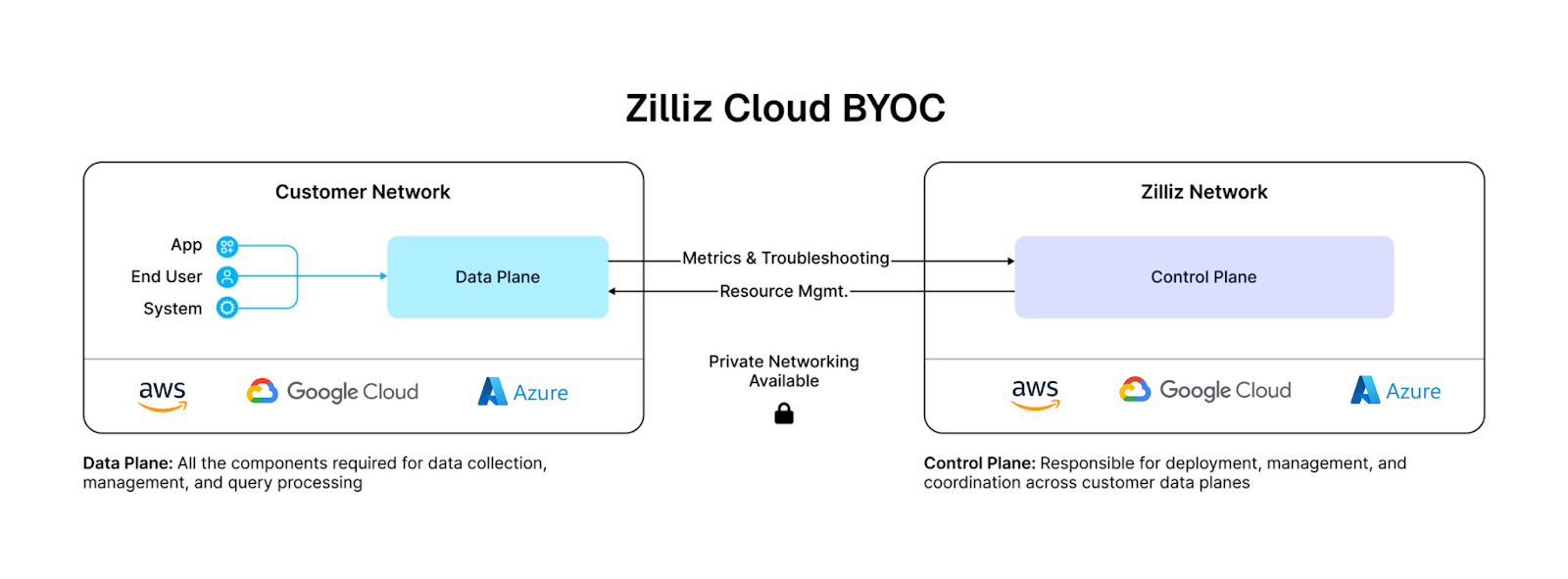
Zilliz Cloud BYOC eliminates this dilemma. With BYOC, the Data Plane deploys directly into your cloud account. Your vectors, indexes, and metadata remain entirely within your Virtual Private Cloud, while Zilliz manages the operational complexity — resource scheduling, cluster provisioning, software updates, health monitoring — through a secure Control Plane. Communication occurs over encrypted channels with strictly controlled access policies, and explicit customer approval is required before any Zilliz engineer takes action.
You maintain full control over network configuration, access policies, and encryption keys. Infrastructure costs flow through your existing cloud billing. Compliance audits rely on your established governance frameworks — not a vendor's. You get managed-service reliability. Your data never leaves your perimeter.
Zilliz Cloud BYOC provides the same vector database capabilities built on Milvus as Zilliz Cloud SaaS offerings—the difference is where your data lives. With SaaS, both the Data Plane and Control Plane run in Zilliz-managed infrastructure — the fastest path to getting started, and the right choice for many applications without strict data residency requirements.
For organizations with the most stringent security requirements, the BYOC-I mode (Infrastructure-controlled mode) goes further — eliminating external infrastructure access entirely and giving you complete authority over all Data Plane resources.
What the Azure Launch Unlocks
The Azure launch completes a deliberate expansion — from AWS, to GCP earlier this year, and now Azure. For the many enterprises standardized on Microsoft's cloud, or operating in hybrid environments, this launch removes the last deployment barrier.
Run alongside your Azure AI stack: Your vector database now sits in the same subscription as Azure OpenAI Service, Azure SQL, and Blob Storage. No cross-cloud data movement, no egress fees, no additional network complexity. If your embeddings are generated by Azure OpenAI, they never need to leave Azure.
Deploy as code from day one. The official Zilliz Cloud Terraform Provider fully automates networking and authentication setup for Azure BYOC, enabling repeatable, version-controlled deployments that slot directly into existing CI/CD and GitOps workflows.
Apply existing investments. Enterprise agreements, reserved capacity, and established cost management practices all apply. BYOC runs on your infrastructure, billed through your Azure account.
Extend your compliance posture. Your existing Azure network security groups, private endpoints, and access policies govern your vector database the same way they govern everything else in your tenant — whether for data residency, industry regulations, or internal governance policies.
One Product, Any Cloud
But this announcement is bigger than Azure. With BYOC available across all three major platforms, including AWS, GCP, and Azure, Zilliz Cloud now fits the way large organizations actually build and operate, which is almost never on a single cloud.
Business units choose different clouds. Your product engineering team may run on AWS. Your analytics group standardized on GCP. The enterprise applications team lives in Azure. Multi-cloud BYOC means every team gets the same vector search capabilities without forcing anyone off their platform of choice.
Data residency requirements vary by region. A European deployment might need to run in a specific Azure region for GDPR compliance, while your US operations run on AWS. Multi-cloud BYOC lets you place vector infrastructure exactly where regulations require, without compromising on capabilities or operational model.
Teams don't want to re-platform to adopt new infrastructure. For organizations with multi-cloud strategies—whether by design or acquisition—having consistent vector database capabilities across all major providers simplifies architecture decisions and reduces risk.
Your cloud strategy may evolve. Organizations that committed to a single provider three years ago are increasingly diversifying. A vector database that works consistently across AWS, GCP, and Azure means one fewer thing to migrate or re-evaluate when your cloud strategy shifts.
In every case, the operational model stays the same: your data stays in your VPC, Zilliz manages the infrastructure, and performance and features remain consistent regardless of provider.
What Every BYOC Deployment Includes
Regardless of which cloud hosts your BYOC deployment, you get access to the full Zilliz Cloud feature set built on Milvus, the most widely adopted open-source vector database:
Performance at Scale: Handle tens of billions of vectors with consistent sub-millisecond latency. Advanced indexing algorithms and query optimization deliver the speed that production AI applications demand.
Advanced AI Search: Combine vector similarity search with traditional filtering, full-text search, and metadata queries in unified operations. Build applications that understand both semantic meaning and structured attributes.
Operational Visibility: Comprehensive audit logging captures every data plane operation—searches, index changes, data modifications—with full execution context. Logs stream directly to your cloud storage for integration with existing security and compliance tooling.
Flexible Scaling: Scale compute and storage independently based on workload characteristics. Predefined project sizes simplify initial deployment, with full customization available for specific requirements.
Enterprise-Grade Reliability and Security. 99.95% SLA, SOC 2 Type II and ISO 27001 certifications, GDPR compliance, HIPAA readiness, RBAC, audit logs, business critical plan, and global clusters. See our trust center for more information.
Seamless Migration. Built-in tools to move from Pinecone, Qdrant, Elasticsearch, PostgreSQL, OpenSearch, AWS S3 vectors, Weaviate, or self-hosted Milvus.
And more!
Getting Started with BYOC on the Cloud You Prefer
Zilliz Cloud BYOC is available now across AWS, GCP, and Azure regions. Multiple paths exist depending on your operational preferences:
Infrastructure as Code: Use our Zilliz Cloud Terraform Provider to automate deployments and integrate with existing IaC workflows.
Deployment Guides: Follow platform-specific documentation for AWS, GCP, or Azure configuration.
Architecture Review: Contact our team to discuss your specific requirements, multi-cloud strategy, or compliance needs.

Keep Reading
Introducing Functions and Model Inference on Zilliz Cloud: Automatic Embedding and Reranking with Hosted Models
Zilliz Cloud Functions auto-generate embeddings via OpenAI, Voyage AI, Cohere, or Zilliz Hosted Models. Built-in reranking — just insert text and search.
Introducing Customer-Managed Encryption Keys (CMEK) on Zilliz Cloud
We're announcing the general availability of Customer-Managed Encryption Keys (CMEK) on Zilliz Cloud.
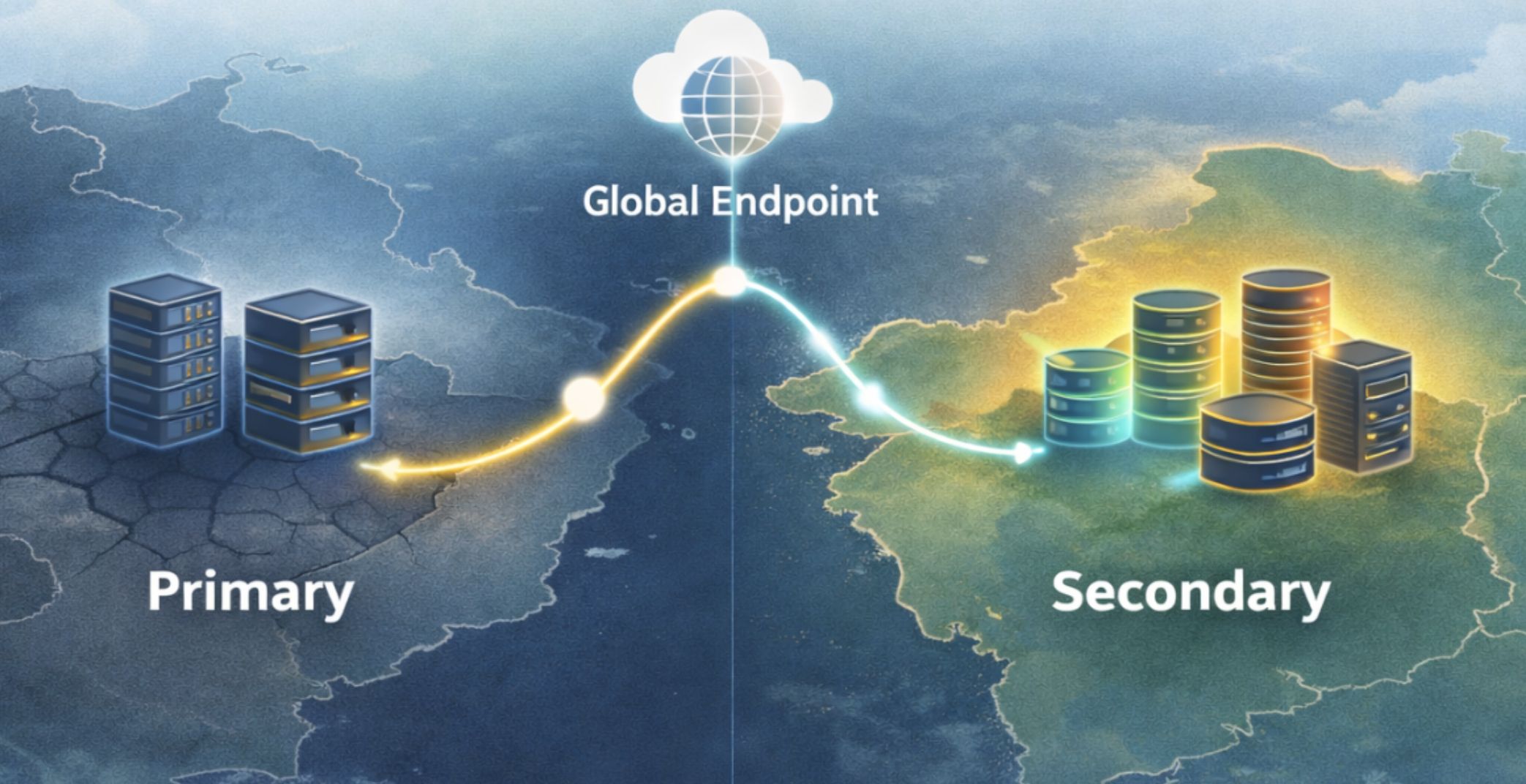
The AWS Outage Was a Wake-Up Call for Vector Database Cross-Region Disaster Recovery
Zilliz Cloud Had the Answer Before the Crisis. Zilliz Cloud is the world's first vector database with native cross-region disaster recovery.