



Vector Transport Service (VTS)
Move Your Vector Data Securely.
Open-Source and Self-Hosted.
Private Infrastructure. Own Your Data Pipeline.
Vector Transport Service (VTS) is the open-source toolkit for securely moving unstructured and vector data in private environments. Deploy anywhere, control everything.
What is Vector Transport Service (VTS)?
Vector Transport Service (VTS) is an open-source data migration tool designed to handle the complex task of moving vectors and unstructured data between different data platforms. It supports migration from all major data sources, including Qdrant, PostgreSQL, Pinecone, Elasticsearch, OpenSearch, etc., to Milvus and Zilliz Cloud, but it requires self-deployment and management.
How does Vector Transport Service (VTS) work?
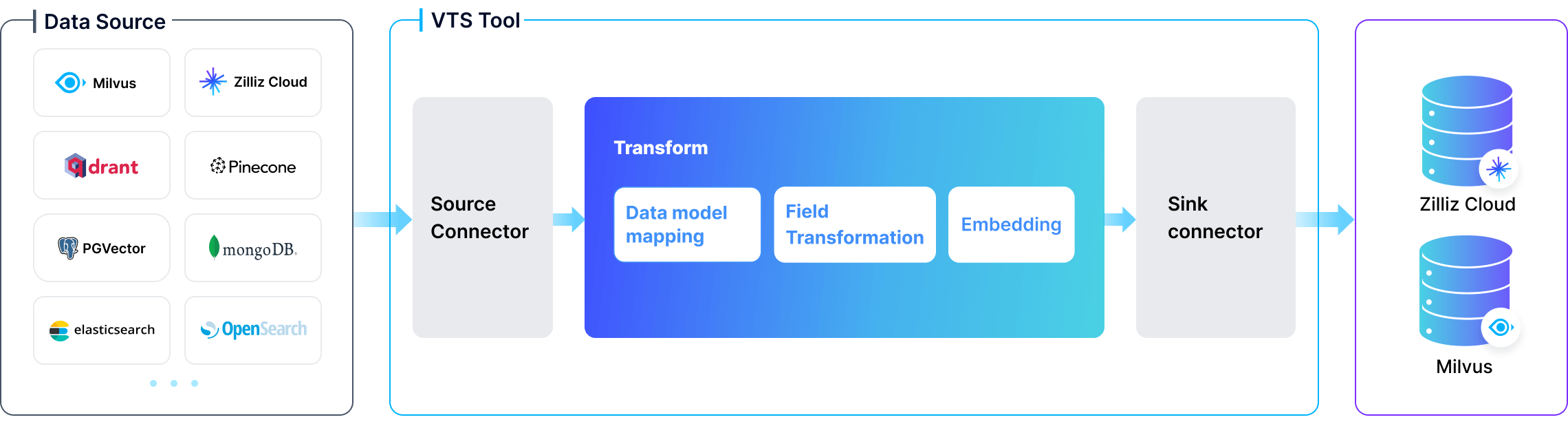
1. Deploy: Install VTS in your environment (Docker or Kubernetes).
2. Connect: Link source and target databases via private network.
3. Transform: Apply schema mappings or embedding conversions.
4. Migrate: Run one-time batches or sync continuously.
Key Benefits of Vector Transport Service (VTS)

Self-Hosted & Open-Source
Deploy VTS in your own infrastructure. Own the code, control the data, and customize every step.

No Public Internet Access Required
Migrate data securely between on-premises databases or air-gapped networks without requiring public internet access.

Scalable & High-Performance
Designed to handle large volumes of unstructured and vector data without compromising speed or reliability.

Enterprise-Ready Flexibility
Batch or streaming modes, custom transformations, and compatibility with Kubernetes for scalable operations.

Broad Compatibility Across Leading Data Platforms
Migrate seamlessly from Elasticsearch, OpenSearch, Pinecone, Qdrant, Milvus, PostgreSQL, and more – whether in the cloud (AWS/Azure/GCP) or on-premises.

Purpose-built for Vector and Unstructured Data
VTS is purpose-built to move unstructured data and vector embeddings across different data sources. It handles schema conflicts, format conversions, and version control for vector data — without rebuilding pipelines from scratch.
Vector Transport Service (VTS) vs Zilliz Migration Service
Zilliz Migration Service is a free, fully managed tool built on VTS, designed specifically for migrating unstructured and vector data. It offers the same powerful capabilities as VTS but with a seamless, out-of-the-box experience and added enterprise support.
| Zilliz Migration Service | Vector Transport Service (VTS) | |
|---|---|---|
| Deployment | Fully managed service built within Zilliz Cloud | Self-hosted and user-managed |
| Ease of Use | Out-of-the-box, no setup required | Requires manual deployment & ongoing maintenance |
| Supported Data Sources | Supports all major data sources (Milvus, Elasticsearch, OpenSearch, Pinecone, Qdrant, PostgreSQL, etc.) | Supports all major data sources (Milvus, Elasticsearch, OpenSearch, Amazon S3 Vectors, Pinecone, Qdrant, Weaviate, PostgreSQL, etc.) |
| Real-Time Sync | Yes, built-in continuous synchronization | Yes, but the configuration is manual |
| Network Requirements | Public access to sources required | Private network compatible |
| Cost | Free and fully managed | Free, but incurs infrastructure and operational costs |
| Best For | Organizations seeking a hassle-free, supported migration experience | Organizations with existing infrastructure that prefer self-management and on-premises environments |
Frequently asked questions
1. What is Vector Transport Service (VTS)?
2. How does VTS work?
3. Which data sources are supported by VTS?
4. How is VTS different from Zilliz Migration Service?
5. How do I deploy VTS in my own environment?
6. Does VTS support zero downtime migration?
7. How does VTS handle data transformation and schema mapping?
8. Is VTS free to use?
9. What are the prerequisites for deploying VTS?
10. Where can I find support and documentation for VTS?