

Build RAG Chatbot with LangChain, Zilliz Cloud, OpenAI GPT-4, and Cohere embed-multilingual-v3.0
Introduction to RAG
Retrieval-Augmented Generation (RAG) is a game-changer for GenAI applications, especially in conversational AI. It combines the power of pre-trained large language models (LLMs) like OpenAI’s GPT with external knowledge sources stored in vector databases such as Milvus and Zilliz Cloud, allowing for more accurate, contextually relevant, and up-to-date response generation. A RAG pipeline usually consists of four basic components: a vector database, an embedding model, an LLM, and a framework.
Key Components We'll Use for This RAG Chatbot
This tutorial shows you how to build a simple RAG chatbot in Python using the following components:
- LangChain: An open-source framework that helps you orchestrate the interaction between LLMs, vector stores, embedding models, etc, making it easier to integrate a RAG pipeline.
- Zilliz Cloud: a fully managed vector database-as-a-service platform built on top of the open-source Milvus, designed to handle high-performance vector data processing at scale. It enables organizations to efficiently store, search, and analyze large volumes of unstructured data, such as text, images, or audio, by leveraging advanced vector search technology. It offers a free tier supporting up to 1 million vectors.
- OpenAI GPT-4: GPT-4 is OpenAI's advanced language model, designed for comprehensive understanding and context-aware text generation. It excels in creative writing, complex problem-solving, and nuanced conversation, making it suitable for applications in content creation, tutoring, and interactive AI. Its robust capabilities enable it to handle a wide range of topics with depth and coherence.
- Cohere embed-multilingual-v3.0: This model provides high-quality multilingual text embeddings, enabling effective semantic understanding across diverse languages. Its strengths lie in capturing nuanced meanings and facilitating cross-lingual search and analysis. Ideal for applications in global customer support, content recommendation, and multilingual data analysis, it enhances multilingual communication and insight extraction.
By the end of this tutorial, you’ll have a functional chatbot capable of answering questions based on a custom knowledge base.
Note: Since we may use proprietary models in our tutorials, make sure you have the required API key beforehand.
Step 1: Install and Set Up LangChain
%pip install --quiet --upgrade langchain-text-splitters langchain-community langgraph
Step 2: Install and Set Up OpenAI GPT-4
pip install -qU "langchain[openai]"
import getpass
import os

if not os.environ.get("OPENAI_API_KEY"):
  os.environ["OPENAI_API_KEY"] = getpass.getpass("Enter API key for OpenAI: ")

from langchain.chat_models import init_chat_model

llm = init_chat_model("gpt-4", model_provider="openai")
Step 3: Install and Set Up Cohere embed-multilingual-v3.0
pip install -qU langchain-cohere
import getpass
import os

if not os.environ.get("COHERE_API_KEY"):
  os.environ["COHERE_API_KEY"] = getpass.getpass("Enter API key for Cohere: ")

from langchain_cohere import CohereEmbeddings

embeddings = CohereEmbeddings(model="embed-multilingual-v3.0")
Step 4: Install and Set Up Zilliz Cloud
pip install -qU langchain-milvus
from langchain_milvus import Zilliz

vector_store = Zilliz(
    embedding_function=embeddings,
    connection_args={
        "uri": ZILLIZ_CLOUD_URI,
        "token": ZILLIZ_CLOUD_TOKEN,
    },
)
Step 5: Build a RAG Chatbot
Now that you’ve set up all components, let’s start to build a simple chatbot. We’ll use the Milvus introduction doc as a private knowledge base. You can replace it with your own dataset to customize your RAG chatbot.
import bs4
from langchain import hub
from langchain_community.document_loaders import WebBaseLoader
from langchain_core.documents import Document
from langchain_text_splitters import RecursiveCharacterTextSplitter
from langgraph.graph import START, StateGraph
from typing_extensions import List, TypedDict

# Load and chunk contents of the blog
loader = WebBaseLoader(
    web_paths=("https://milvus.io/docs/overview.md",),
    bs_kwargs=dict(
        parse_only=bs4.SoupStrainer(
            class_=("doc-style doc-post-content")
        )
    ),
)

docs = loader.load()

text_splitter = RecursiveCharacterTextSplitter(chunk_size=1000, chunk_overlap=200)
all_splits = text_splitter.split_documents(docs)

# Index chunks
_ = vector_store.add_documents(documents=all_splits)

# Define prompt for question-answering
prompt = hub.pull("rlm/rag-prompt")


# Define state for application
class State(TypedDict):
    question: str
    context: List[Document]
    answer: str


# Define application steps
def retrieve(state: State):
    retrieved_docs = vector_store.similarity_search(state["question"])
    return {"context": retrieved_docs}


def generate(state: State):
    docs_content = "\n\n".join(doc.page_content for doc in state["context"])
    messages = prompt.invoke({"question": state["question"], "context": docs_content})
    response = llm.invoke(messages)
    return {"answer": response.content}


# Compile application and test
graph_builder = StateGraph(State).add_sequence([retrieve, generate])
graph_builder.add_edge(START, "retrieve")
graph = graph_builder.compile()
Test the Chatbot
Yeah! You've built your own chatbot. Let's ask the chatbot a question.
response = graph.invoke({"question": "What data types does Milvus support?"})
print(response["answer"])
Example Output
Milvus supports various data types including sparse vectors, binary vectors, JSON, and arrays. Additionally, it handles common numerical and character types, making it versatile for different data modeling needs. This allows users to manage unstructured or multi-modal data efficiently.
Optimization Tips
As you build your RAG system, optimization is key to ensuring peak performance and efficiency. While setting up the components is an essential first step, fine-tuning each one will help you create a solution that works even better and scales seamlessly. In this section, we’ll share some practical tips for optimizing all these components, giving you the edge to build smarter, faster, and more responsive RAG applications.
LangChain optimization tips
To optimize LangChain, focus on minimizing redundant operations in your workflow by structuring your chains and agents efficiently. Use caching to avoid repeated computations, speeding up your system, and experiment with modular design to ensure that components like models or databases can be easily swapped out. This will provide both flexibility and efficiency, allowing you to quickly scale your system without unnecessary delays or complications.
Zilliz Cloud optimization tips
Optimizing Zilliz Cloud for a RAG system involves efficient index selection, query tuning, and resource management. Use Hierarchical Navigable Small World (HNSW) indexing for high-speed, approximate nearest neighbor search while balancing recall and efficiency. Fine-tune ef_construction and M parameters based on your dataset size and query workload to optimize search accuracy and latency. Enable dynamic scaling to handle fluctuating workloads efficiently, ensuring smooth performance under varying query loads. Implement data partitioning to improve retrieval speed by grouping related data, reducing unnecessary comparisons. Regularly update and optimize embeddings to keep results relevant, particularly when dealing with evolving datasets. Use hybrid search techniques, such as combining vector and keyword search, to improve response quality. Monitor system metrics in Zilliz Cloud’s dashboard and adjust configurations accordingly to maintain low-latency, high-throughput performance.
OpenAI GPT-4 optimization tips
GPT-4 is a powerful model for RAG applications, but optimizing retrieval and prompt efficiency is key to reducing costs and improving response quality. Use embedding-based retrieval to ensure highly relevant context is included while avoiding unnecessary token usage. Structure prompts concisely, presenting retrieved documents in a clear, ranked format to guide the model’s focus. Fine-tune temperature (0.1–0.3) for fact-based tasks and adjust top-p and top-k sampling to control response variability. Implement caching for frequently queried information to reduce redundant API calls and improve latency. If using GPT-4 in high-traffic applications, batch requests to minimize overhead and optimize throughput. Leverage OpenAI’s function-calling capabilities to structure responses programmatically and avoid excessive hallucinations. Use response streaming for real-time applications to improve perceived performance while maintaining efficient token usage.
Cohere embed-multilingual-v3.0 optimization tips
Cohere embed-multilingual-v3.0 is designed for multilingual support, making it highly useful in global RAG systems. To optimize performance, preprocess multilingual input by handling language-specific quirks, such as tokenization and special characters, to maintain consistency across different languages. Implement language detection models to filter and route queries to the appropriate language embeddings, improving both speed and relevance. Use indexing structures like FAISS or HNSW to speed up search across multilingual datasets. Compress embeddings using techniques like quantization to optimize storage while ensuring quality. To handle scalability, leverage distributed storage systems for efficient management of multilingual embeddings. Continuously retrain and update embeddings to reflect new languages or evolving language models.
By implementing these tips across your components, you'll be able to enhance the performance and functionality of your RAG system, ensuring it’s optimized for both speed and accuracy. Keep testing, iterating, and refining your setup to stay ahead in the ever-evolving world of AI development.
RAG Cost Calculator: A Free Tool to Calculate Your Cost in Seconds
Estimating the cost of a Retrieval-Augmented Generation (RAG) pipeline involves analyzing expenses across vector storage, compute resources, and API usage. Key cost drivers include vector database queries, embedding generation, and LLM inference.
RAG Cost Calculator is a free tool that quickly estimates the cost of building a RAG pipeline, including chunking, embedding, vector storage/search, and LLM generation. It also helps you identify cost-saving opportunities and achieve up to 10x cost reduction on vector databases with the serverless option.
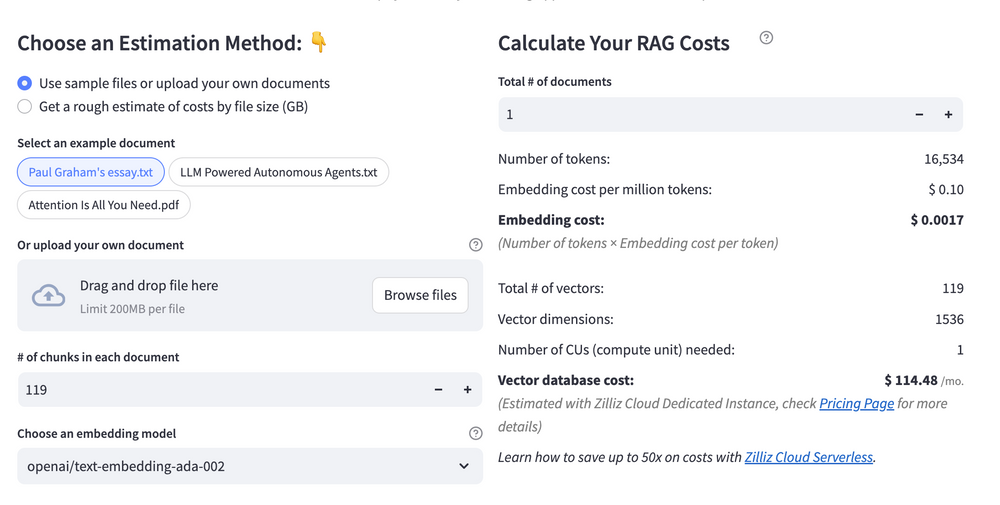 Calculate your RAG cost
What Have You Learned?
What have you learned? Throughout this tutorial, we’ve taken an exhilarating journey to build a state-of-the-art Retrieval-Augmented Generation (RAG) system! We dove into how each component flawlessly integrates to create a powerful architecture. We began with the framework, which serves as the backbone of our project, bringing together all the moving parts and ensuring seamless interaction. Next, we explored the vector database, Zilliz Cloud, that supercharges our ability to search through vast amounts of data super-fast. You'll be amazed at how efficiently it retrieves relevant information, allowing our system to scale dynamically!
Then, we unleashed the potential of the OpenAI GPT-4 language model, which brings conversational intelligence to your application—transforming those retrieved snippets into meaningful dialogues! Furthermore, we used the Cohere embed-multilingual-v3.0 model to generate rich and nuanced embeddings. This model allowed us to capture the depth and context of language in a way that's truly remarkable.
We even tossed in some hands-on optimization tips and a free cost calculator to help you on your way. The possibilities are endless, and now it’s your turn! I can’t wait for you to dive in, build, optimize, and innovate your own RAG applications. The future of intelligent systems is at your fingertips—start creating today!
Further Resources
🌟 In addition to this RAG tutorial, unleash your full potential with these incredible resources to level up your RAG skills.
- How to Build a Multimodal RAG | Documentation
- How to Enhance the Performance of Your RAG Pipeline
- Graph RAG with Milvus | Documentation
- How to Evaluate RAG Applications - Zilliz Learn
- Generative AI Resource Hub | Zilliz
We'd Love to Hear What You Think!
We’d love to hear your thoughts! 🌟 Leave your questions or comments below or join our vibrant Milvus Discord community to share your experiences, ask questions, or connect with thousands of AI enthusiasts. Your journey matters to us!
If you like this tutorial, show your support by giving our Milvus GitHub repo a star ⭐—it means the world to us and inspires us to keep creating! 💖
Content
- Introduction to RAG
- Key Components We'll Use for This RAG Chatbot
- Step 1: Install and Set Up LangChain
- Step 2: Install and Set Up OpenAI GPT-4
- Step 3: Install and Set Up Cohere embed-multilingual-v3.0
- Step 4: Install and Set Up Zilliz Cloud
- Step 5: Build a RAG Chatbot
- Optimization Tips
- RAG Cost Calculator: A Free Tool to Calculate Your Cost in Seconds
- What Have You Learned?
- Further Resources
- We'd Love to Hear What You Think!
Vector Database at Scale
Zilliz Cloud is a fully-managed vector database built for scale, perfect for your RAG apps.
Try Zilliz Cloud for Free