


Build RAG Chatbot with LangChain, LangChain vector store, OpenAI GPT-4o mini, and Cohere embed-multilingual-v2.0
Introduction to RAG
Retrieval-Augmented Generation (RAG) is a game-changer for GenAI applications, especially in conversational AI. It combines the power of pre-trained large language models (LLMs) like OpenAI’s GPT with external knowledge sources stored in vector databases such as Milvus and Zilliz Cloud, allowing for more accurate, contextually relevant, and up-to-date response generation. A RAG pipeline usually consists of four basic components: a vector database, an embedding model, an LLM, and a framework.
Key Components We'll Use for This RAG Chatbot
This tutorial shows you how to build a simple RAG chatbot in Python using the following components:
- LangChain: An open-source framework that helps you orchestrate the interaction between LLMs, vector stores, embedding models, etc, making it easier to integrate a RAG pipeline.
- LangChain in-memory vector store: an in-memory, ephemeral vector store that stores embeddings in-memory and does an exact, linear search for the most similar embeddings. The default similarity metric is cosine similarity, but can be changed to any of the similarity metrics supported by ml-distance. It is intended for demos and does not yet support ids or deletion. (If you want a much more scalable solution for your apps or even enterprise projects, we recommend using Zilliz Cloud, which is a fully managed vector database service built on the open-source Milvusand offers a free tier supporting up to 1 million vectors.)
- OpenAI GPT-4o mini: This model is a compact version of the advanced GPT-4 architecture, designed for efficiency and lower resource consumption. It delivers strong performance in natural language understanding and generation tasks, making it ideal for chatbot implementations, content creation, and interactive applications where responsiveness and cost-effectiveness are crucial.
- Cohere embed-multilingual-v2.0: This model specializes in generating high-quality multilingual embeddings, enabling effective cross-lingual understanding and retrieval. Its strengths lie in capturing semantic relationships in diverse languages, making it suitable for applications such as multilingual search, recommendation systems, and global content analysis where language diversity is a critical factor.
By the end of this tutorial, you’ll have a functional chatbot capable of answering questions based on a custom knowledge base.
Note: Since we may use proprietary models in our tutorials, make sure you have the required API key beforehand.
Step 1: Install and Set Up LangChain
%pip install --quiet --upgrade langchain-text-splitters langchain-community langgraph
Step 2: Install and Set Up OpenAI GPT-4o mini
pip install -qU "langchain[openai]"
import getpass
import os

if not os.environ.get("OPENAI_API_KEY"):
  os.environ["OPENAI_API_KEY"] = getpass.getpass("Enter API key for OpenAI: ")

from langchain.chat_models import init_chat_model

llm = init_chat_model("gpt-4o-mini", model_provider="openai")
Step 3: Install and Set Up Cohere embed-multilingual-v2.0
pip install -qU langchain-cohere
import getpass
import os

if not os.environ.get("COHERE_API_KEY"):
  os.environ["COHERE_API_KEY"] = getpass.getpass("Enter API key for Cohere: ")

from langchain_cohere import CohereEmbeddings

embeddings = CohereEmbeddings(model="embed-multilingual-v2.0")
Step 4: Install and Set Up LangChain vector store
pip install -qU langchain-core
from langchain_core.vectorstores import InMemoryVectorStore

vector_store = InMemoryVectorStore(embeddings)
Step 5: Build a RAG Chatbot
Now that you’ve set up all components, let’s start to build a simple chatbot. We’ll use the Milvus introduction doc as a private knowledge base. You can replace it with your own dataset to customize your RAG chatbot.
import bs4
from langchain import hub
from langchain_community.document_loaders import WebBaseLoader
from langchain_core.documents import Document
from langchain_text_splitters import RecursiveCharacterTextSplitter
from langgraph.graph import START, StateGraph
from typing_extensions import List, TypedDict

# Load and chunk contents of the blog
loader = WebBaseLoader(
    web_paths=("https://milvus.io/docs/overview.md",),
    bs_kwargs=dict(
        parse_only=bs4.SoupStrainer(
            class_=("doc-style doc-post-content")
        )
    ),
)

docs = loader.load()

text_splitter = RecursiveCharacterTextSplitter(chunk_size=1000, chunk_overlap=200)
all_splits = text_splitter.split_documents(docs)

# Index chunks
_ = vector_store.add_documents(documents=all_splits)

# Define prompt for question-answering
prompt = hub.pull("rlm/rag-prompt")


# Define state for application
class State(TypedDict):
    question: str
    context: List[Document]
    answer: str


# Define application steps
def retrieve(state: State):
    retrieved_docs = vector_store.similarity_search(state["question"])
    return {"context": retrieved_docs}


def generate(state: State):
    docs_content = "\n\n".join(doc.page_content for doc in state["context"])
    messages = prompt.invoke({"question": state["question"], "context": docs_content})
    response = llm.invoke(messages)
    return {"answer": response.content}


# Compile application and test
graph_builder = StateGraph(State).add_sequence([retrieve, generate])
graph_builder.add_edge(START, "retrieve")
graph = graph_builder.compile()
Test the Chatbot
Yeah! You've built your own chatbot. Let's ask the chatbot a question.
response = graph.invoke({"question": "What data types does Milvus support?"})
print(response["answer"])
Example Output
Milvus supports various data types including sparse vectors, binary vectors, JSON, and arrays. Additionally, it handles common numerical and character types, making it versatile for different data modeling needs. This allows users to manage unstructured or multi-modal data efficiently.
Optimization Tips
As you build your RAG system, optimization is key to ensuring peak performance and efficiency. While setting up the components is an essential first step, fine-tuning each one will help you create a solution that works even better and scales seamlessly. In this section, we’ll share some practical tips for optimizing all these components, giving you the edge to build smarter, faster, and more responsive RAG applications.
LangChain optimization tips
To optimize LangChain, focus on minimizing redundant operations in your workflow by structuring your chains and agents efficiently. Use caching to avoid repeated computations, speeding up your system, and experiment with modular design to ensure that components like models or databases can be easily swapped out. This will provide both flexibility and efficiency, allowing you to quickly scale your system without unnecessary delays or complications.
LangChain in-memory vector store optimization tips
LangChain in-memory vector store is just an ephemeral vector store that stores embeddings in-memory and does an exact, linear search for the most similar embeddings. It has very limited features and is only intended for demos. If you plan to build a functional or even production-level solution, we recommend using Zilliz Cloud, which is a fully managed vector database service built on the open-source Milvus and offers a free tier supporting up to 1 million vectors.)
OpenAI GPT-4o mini optimization tips
GPT-4o mini is a smaller and more cost-effective variant of GPT-4o, making it ideal for low-latency RAG applications. Optimize retrieval by limiting the number of retrieved documents to only the most relevant, ensuring the model does not get overloaded with unnecessary context. Structure prompts effectively by using bullet points or numbered lists to enhance clarity and focus. Keep temperature at 0.1–0.2 for factual responses, adjusting top-p and top-k values to refine output precision. Implement caching for frequently accessed queries to minimize API calls and reduce costs. For high-throughput applications, batch process multiple queries to optimize API efficiency. Stream responses to improve interactivity in real-time applications. If using GPT-4o mini in a multi-model pipeline, consider using it for simpler tasks while reserving larger models for complex reasoning.
Cohere embed-multilingual-v2.0 optimization tips
Cohere embed-multilingual-v2.0 supports a variety of languages, making it ideal for cross-lingual RAG setups. To optimize efficiency, preprocess text to remove language-specific noise and handle encoding issues, ensuring clean input for embedding generation. Implement efficient ANN algorithms, like FAISS with hierarchical indexing, to support fast retrieval across multilingual datasets. Compress embeddings using techniques such as product quantization or HNSW to optimize storage and speed. Use language detection models to route queries to the appropriate language-specific embeddings, minimizing unnecessary computation. Batch embedding operations and take advantage of parallel processing to handle large amounts of multilingual data efficiently. Regularly update embeddings to ensure the model reflects any language shifts or evolving trends.
By implementing these tips across your components, you'll be able to enhance the performance and functionality of your RAG system, ensuring it’s optimized for both speed and accuracy. Keep testing, iterating, and refining your setup to stay ahead in the ever-evolving world of AI development.
RAG Cost Calculator: A Free Tool to Calculate Your Cost in Seconds
Estimating the cost of a Retrieval-Augmented Generation (RAG) pipeline involves analyzing expenses across vector storage, compute resources, and API usage. Key cost drivers include vector database queries, embedding generation, and LLM inference.
RAG Cost Calculator is a free tool that quickly estimates the cost of building a RAG pipeline, including chunking, embedding, vector storage/search, and LLM generation. It also helps you identify cost-saving opportunities and achieve up to 10x cost reduction on vector databases with the serverless option.
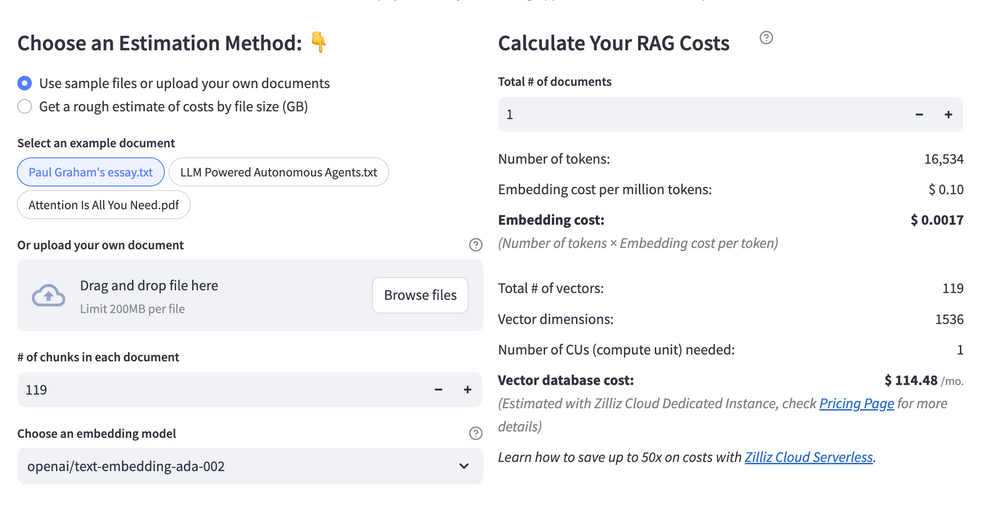 Calculate your RAG cost
What Have You Learned?
What Have You Learned?
Congratulations on completing this tutorial! You’ve just unlocked the secrets to building a state-of-the-art RAG (Retrieval-Augmented Generation) system using an innovative blend of a dynamic framework, a powerful vector database, a cutting-edge LLM, and a robust embedding model. Isn’t it exciting? Let’s take a moment to appreciate how each of these components works in harmony to create something truly remarkable. The framework you’ve explored ties everything together seamlessly, enabling effortless integration and ensuring that you can focus on the creative aspects of your application. The vector database delivers rapid, efficient searches, making it easy to retrieve data quickly and accurately, which is vital when you want to maximize user experience.
You’ve learned how the LLM, powered by OpenAI’s GPT-4o mini, elevates your application with exceptional conversational intelligence, allowing for nuanced dialogues and engaging interactions. Through the embedding model, you’re generating rich, semantic representations that capture the essence of your data, ensuring relevance and insight in every response. We also introduced optimization tips and a handy free cost calculator, which can help you fine-tune your application for the best performance while keeping an eye on your budget.
Now that you have this invaluable knowledge, it’s your turn to shine! Dive in, start building your own RAG applications, optimize your designs, and innovate like never before. The tools are in your hands, and the possibilities are endless. Your journey in the world of artificial intelligence awaits—let’s bring your ideas to life!
Further Resources
🌟 In addition to this RAG tutorial, unleash your full potential with these incredible resources to level up your RAG skills.
- How to Build a Multimodal RAG | Documentation
- How to Enhance the Performance of Your RAG Pipeline
- Graph RAG with Milvus | Documentation
- How to Evaluate RAG Applications - Zilliz Learn
- Generative AI Resource Hub | Zilliz
We'd Love to Hear What You Think!
We’d love to hear your thoughts! 🌟 Leave your questions or comments below or join our vibrant Milvus Discord community to share your experiences, ask questions, or connect with thousands of AI enthusiasts. Your journey matters to us!
If you like this tutorial, show your support by giving our Milvus GitHub repo a star ⭐—it means the world to us and inspires us to keep creating! 💖
- Introduction to RAG
- Key Components We'll Use for This RAG Chatbot
- Step 1: Install and Set Up LangChain
- Step 2: Install and Set Up OpenAI GPT-4o mini
- Step 3: Install and Set Up Cohere embed-multilingual-v2.0
- Step 4: Install and Set Up LangChain vector store
- Step 5: Build a RAG Chatbot
- Optimization Tips
- RAG Cost Calculator: A Free Tool to Calculate Your Cost in Seconds
- What Have You Learned?
- Further Resources
- We'd Love to Hear What You Think!
anchor.title
Vector Database at Scale
Zilliz Cloud is a fully-managed vector database built for scale, perfect for your RAG apps.
Try Zilliz Cloud for Free