Build RAG Chatbot with Llamaindex, OpenSearch, Mistral Ministral 8B, and Ollama paraphrase-multilingual
Introduction to RAG
Retrieval-Augmented Generation (RAG) is a game-changer for GenAI applications, especially in conversational AI. It combines the power of pre-trained large language models (LLMs) like OpenAI’s GPT with external knowledge sources stored in vector databases such as Milvus and Zilliz Cloud, allowing for more accurate, contextually relevant, and up-to-date response generation. A RAG pipeline usually consists of four basic components: a vector database, an embedding model, an LLM, and a framework.
Key Components We'll Use for This RAG Chatbot
This tutorial shows you how to build a simple RAG chatbot in Python using the following components:
- Llamaindex: a data framework that connects large language models (LLMs) with various data sources, enabling efficient retrieval-augmented generation (RAG). It helps structure, index, and query private or external data, optimizing LLM applications for search, chatbots, and analytics.
- OpenSearch: An open-source search and analytics suite derived from Elasticsearch. It offers robust full-text search and real-time analytics, with vector search available as an add-on for similarity-based queries, extending its capabilities to handle high-dimensional data. Since it is just a vector search add-on rather than a purpose-built vector database, it lacks scalability and availability and many other advanced features required by enterprise-level applications. Therefore, if you prefer a much more scalable solution or hate to manage your own infrastructure, we recommend using Zilliz Cloud, which is a fully managed vector database service built on the open-source Milvus and offers a free tier supporting up to 1 million vectors.)
- Mistral Ministral 8B: A compact, high-efficiency language model optimized for scalable natural language processing. It excels in rapid text generation, multilingual tasks, and context-aware reasoning while maintaining low computational demands. Ideal for real-time chatbots, content summarization, and edge-device deployment where speed and resource efficiency are critical.
- Ollama Paraphrase-Multilingual: A versatile AI model designed to rephrase and restructure text across multiple languages while preserving meaning. Strengths include multilingual adaptability, context retention, and semantic accuracy. Ideal for translation enhancement, cross-lingual content generation, global customer support, and academic or technical writing requiring nuanced paraphrasing in diverse linguistic contexts.
By the end of this tutorial, you’ll have a functional chatbot capable of answering questions based on a custom knowledge base.
Note: Since we may use proprietary models in our tutorials, make sure you have the required API key beforehand.
Step 1: Install and Set Up Llamaindex
pip install llama-index
Step 2: Install and Set Up Mistral Ministral 8B
%pip install llama-index-llms-mistralai
from llama_index.llms.mistralai import MistralAI

llm = MistralAI(model="ministral-8b-latest")
Step 3: Install and Set Up Ollama paraphrase-multilingual
%pip install llama-index-embeddings-ollama
from llama_index.embeddings.ollama import OllamaEmbedding

embed_model = OllamaEmbedding(
    model_name="paraphrase-multilingual",
)
Step 4: Install and Set Up OpenSearch
%pip install llama-index-vector-stores-opensearch
from os import getenv
from llama_index.core import SimpleDirectoryReader
from llama_index.vector_stores.opensearch import (
    OpensearchVectorStore,
    OpensearchVectorClient,
)
from llama_index.core import VectorStoreIndex, StorageContext

# http endpoint for your cluster (opensearch required for vector index usage)
endpoint = getenv("OPENSEARCH_ENDPOINT", "http://localhost:9200")
# index to demonstrate the VectorStore impl
idx = getenv("OPENSEARCH_INDEX", "gpt-index-demo")
# OpensearchVectorClient stores text in this field by default
text_field = "content"
# OpensearchVectorClient stores embeddings in this field by default
embedding_field = "embedding"
# OpensearchVectorClient encapsulates logic for a
# single opensearch index with vector search enabled
client = OpensearchVectorClient(
    endpoint, idx, 1536, embedding_field=embedding_field, text_field=text_field
)
# initialize vector store
vector_store = OpensearchVectorStore(client)
Step 5: Build a RAG Chatbot
Now that you’ve set up all components, let’s start to build a simple chatbot. We’ll use the Milvus introduction doc as a private knowledge base. You can replace it with your own dataset to customize your RAG chatbot.
import requests

from llama_index.core import SimpleDirectoryReader

# load documents
url = 'https://raw.githubusercontent.com/milvus-io/milvus-docs/refs/heads/v2.5.x/site/en/about/overview.md'
example_file = 'example_file.md'  # You can replace it with your own file paths.
response = requests.get(url)
with open(example_file, 'wb') as f:
    f.write(response.content)
documents = SimpleDirectoryReader(
    input_files=[example_file]
).load_data()

print("Document ID:", documents[0].doc_id)

storage_context = StorageContext.from_defaults(vector_store=vector_store)
index = VectorStoreIndex.from_documents(
    documents, storage_context=storage_context, embed_model=embed_model
)

query_engine = index.as_query_engine(llm=llm)
res = query_engine.query("What is Milvus?")  # You can replace it with your own question.
print(res)
Example output
Milvus is a high-performance, highly scalable vector database designed to operate efficiently across various environments, from personal laptops to large-scale distributed systems. It is available as both open-source software and a cloud service. Milvus excels in managing unstructured data by converting it into numerical vectors through embeddings, which facilitates fast and scalable searches and analytics. The database supports a wide range of data types and offers robust data modeling capabilities, allowing users to organize their data effectively. Additionally, Milvus provides multiple deployment options, including a lightweight version for quick prototyping and a distributed version for handling massive data scales.
Optimization Tips
As you build your RAG system, optimization is key to ensuring peak performance and efficiency. While setting up the components is an essential first step, fine-tuning each one will help you create a solution that works even better and scales seamlessly. In this section, we’ll share some practical tips for optimizing all these components, giving you the edge to build smarter, faster, and more responsive RAG applications.
LlamaIndex optimization tips
To optimize LlamaIndex for a Retrieval-Augmented Generation (RAG) setup, structure your data efficiently using hierarchical indices like tree-based or keyword-table indices for faster retrieval. Use embeddings that align with your use case to improve search relevance. Fine-tune chunk sizes to balance context length and retrieval precision. Enable caching for frequently accessed queries to enhance performance. Optimize metadata filtering to reduce unnecessary search space and improve speed. If using vector databases, ensure indexing strategies align with your query patterns. Implement async processing to handle large-scale document ingestion efficiently. Regularly monitor query performance and adjust indexing parameters as needed for optimal results.
OpenSearch optimization tips
To optimize OpenSearch in a Retrieval-Augmented Generation (RAG) setup, fine-tune indexing by enabling efficient mappings and reducing unnecessary stored fields. Use HNSW for vector search to speed up similarity queries while balancing recall and latency with appropriate ef_search and ef_construction values. Leverage shard and replica settings to distribute load effectively, and enable caching for frequent queries. Optimize text-based retrieval with BM25 tuning and custom analyzers for better relevance. Regularly monitor cluster health, index size, and query performance using OpenSearch Dashboards and adjust configurations accordingly.
Mistral Ministral 8B optimization tips
To optimize Mistral Ministral 8B in RAG setups, ensure input prompts are tightly formatted with clear context-question separation using [INST] tags. Use smaller retrieval chunks (256-512 tokens) to reduce noise and improve relevance. Adjust the temperature (0.1-0.3) for deterministic, fact-focused outputs. Employ a hybrid retrieval approach (dense + sparse methods) to balance precision and recall. Prune retrieved documents with cross-encoder re-rankers before feeding to the model. Limit input context length to avoid truncation, and fine-tune the model on domain-specific data for better alignment. Enable flash attention and quantization (e.g., 4-bit) to reduce latency and memory usage.
Ollama paraphrase-multilingual optimization tips
To optimize Ollama paraphrase-multilingual in a RAG setup, preprocess input text to remove noise and standardize formats (e.g., lowercasing, punctuation normalization). Use smaller temperature values (e.g., 0.3) for deterministic outputs and adjust max_length to balance context retention and brevity. Batch processing parallelizes paraphrasing for efficiency. Cache frequent or repetitive queries to reduce redundant computations. Validate outputs with metrics like BLEU or semantic similarity scores. For multilingual use, explicitly specify language codes in prompts to avoid ambiguity. Fine-tune on domain-specific data if available, and leverage GPU acceleration for faster inference.
By implementing these tips across your components, you'll be able to enhance the performance and functionality of your RAG system, ensuring it’s optimized for both speed and accuracy. Keep testing, iterating, and refining your setup to stay ahead in the ever-evolving world of AI development.
RAG Cost Calculator: A Free Tool to Calculate Your Cost in Seconds
Estimating the cost of a Retrieval-Augmented Generation (RAG) pipeline involves analyzing expenses across vector storage, compute resources, and API usage. Key cost drivers include vector database queries, embedding generation, and LLM inference.
RAG Cost Calculator is a free tool that quickly estimates the cost of building a RAG pipeline, including chunking, embedding, vector storage/search, and LLM generation. It also helps you identify cost-saving opportunities and achieve up to 10x cost reduction on vector databases with the serverless option.
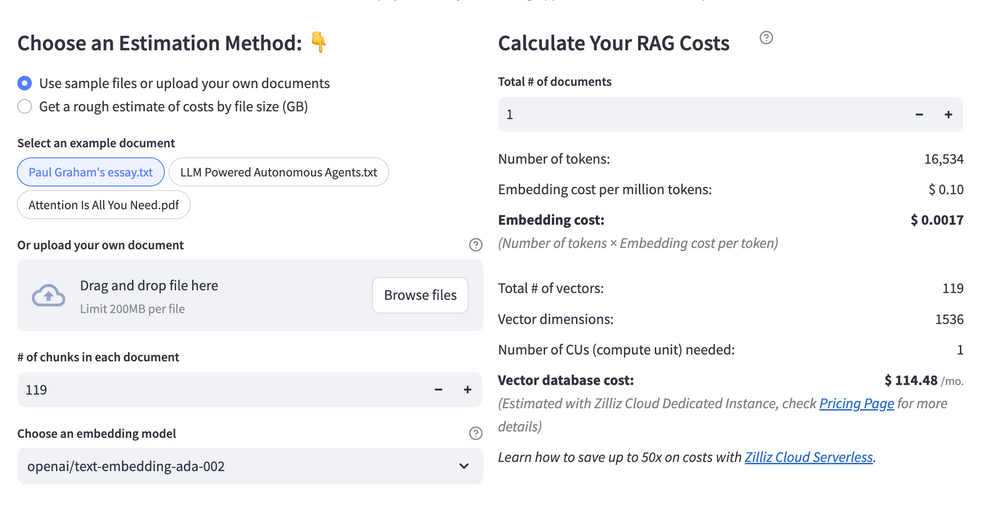 Calculate your RAG cost
What Have You Learned?
Congratulations on reaching the end of this tutorial! You've done a fantastic job diving into the exciting world of Retrieval-Augmented Generation (RAG) systems. By exploring the integration of LlamaIndex, OpenSearch, the powerful Mistral Ministral 8B LLM, and an advanced embedding model, you've unlocked a treasure trove of possibilities for building intelligent applications. Each component plays a crucial role: LlamaIndex streamlines your data, OpenSearch efficiently manages and retrieves it, Mistral handles the language generation, and the embedding model ensures your vectors are precisely tuned for optimal performance. Together, they create a seamless pipeline that can significantly enhance information retrieval and content generation.
But wait, there’s more! You also learned some fantastic optimization tips that can help you maximize the potential of your RAG system. Plus, with the free RAG cost calculator included in the tutorial, you have the tools to assess your project’s financial viability easily. How exciting is it to know that you can now apply these insights to your own innovative ideas? So go ahead and start building, optimizing, and pushing the boundaries of what's possible with RAG applications. The future of intelligent retrieval and generation is in your hands – let your creativity soar!
Further Resources
🌟 In addition to this RAG tutorial, unleash your full potential with these incredible resources to level up your RAG skills.
- How to Build a Multimodal RAG | Documentation
- How to Enhance the Performance of Your RAG Pipeline
- Graph RAG with Milvus | Documentation
- How to Evaluate RAG Applications - Zilliz Learn
- Generative AI Resource Hub | Zilliz
We'd Love to Hear What You Think!
We’d love to hear your thoughts! 🌟 Leave your questions or comments below or join our vibrant Milvus Discord community to share your experiences, ask questions, or connect with thousands of AI enthusiasts. Your journey matters to us!
If you like this tutorial, show your support by giving our Milvus GitHub repo a star ⭐—it means the world to us and inspires us to keep creating! 💖
- Introduction to RAG
- Key Components We'll Use for This RAG Chatbot
- Step 1: Install and Set Up Llamaindex
- Step 2: Install and Set Up Mistral Ministral 8B
- Step 3: Install and Set Up Ollama paraphrase-multilingual
- Step 4: Install and Set Up OpenSearch
- Step 5: Build a RAG Chatbot
- Optimization Tips
- RAG Cost Calculator: A Free Tool to Calculate Your Cost in Seconds
- What Have You Learned?
- Further Resources
- We'd Love to Hear What You Think!
Content
Vector Database at Scale
Zilliz Cloud is a fully-managed vector database built for scale, perfect for your RAG apps.
Try Zilliz Cloud for Free