Build RAG Chatbot with Haystack, OpenSearch, Mistral Nemo, and BAAI llm-embedder
Introduction to RAG
Retrieval-Augmented Generation (RAG) is a game-changer for GenAI applications, especially in conversational AI. It combines the power of pre-trained large language models (LLMs) like OpenAI’s GPT with external knowledge sources stored in vector databases such as Milvus and Zilliz Cloud, allowing for more accurate, contextually relevant, and up-to-date response generation. A RAG pipeline usually consists of four basic components: a vector database, an embedding model, an LLM, and a framework.
Key Components We'll Use for This RAG Chatbot
This tutorial shows you how to build a simple RAG chatbot in Python using the following components:
- Haystack: An open-source Python framework designed for building production-ready NLP applications, particularly question answering and semantic search systems. Haystack excels at retrieving information from large document collections through its modular architecture that combines retrieval and reader components. Ideal for developers creating search applications, chatbots, and knowledge management systems that require efficient document processing and accurate information extraction from unstructured text.
- OpenSearch: An open-source search and analytics suite derived from Elasticsearch. It offers robust full-text search and real-time analytics, with vector search available as an add-on for similarity-based queries, extending its capabilities to handle high-dimensional data. Since it is just a vector search add-on rather than a purpose-built vector database, it lacks scalability and availability and many other advanced features required by enterprise-level applications. Therefore, if you prefer a much more scalable solution or hate to manage your own infrastructure, we recommend using Zilliz Cloud, which is a fully managed vector database service built on the open-source Milvus and offers a free tier supporting up to 1 million vectors.)
- Mistral Nemo: A high-efficiency multilingual AI model optimized for natural language understanding and generation. It excels in low-latency conversational applications, offering robust performance across languages with minimal computational resources. Ideal for real-time chatbots, customer service automation, and scalable multilingual NLP tasks requiring accuracy and speed.
- BAAI llm-embedder: A unified embedding model designed to enhance retrieval-augmented LLMs by generating high-quality text representations. It excels in cross-domain knowledge integration, robustness, and semantic accuracy, making it ideal for retrieval systems, question answering, and textual analysis tasks requiring precise contextual understanding and scalability.
By the end of this tutorial, you’ll have a functional chatbot capable of answering questions based on a custom knowledge base.
Note: Since we may use proprietary models in our tutorials, make sure you have the required API key beforehand.
Step 1: Install and Set Up Haystack
import os
import requests

from haystack import Pipeline
from haystack.components.converters import MarkdownToDocument

from haystack.components.preprocessors import DocumentSplitter
from haystack.components.writers import DocumentWriter
Step 2: Install and Set Up Mistral Nemo
To use Mistral models, you need first to get a Mistral API key. You can write this key in:
- The
api_keyinit parameter using Secret API - The
MISTRAL_API_KEYenvironment variable (recommended)
Now, after you get the API key, let's install the Install the mistral-haystack package.
pip install mistral-haystack
from haystack_integrations.components.generators.mistral import MistralChatGenerator
from haystack.components.generators.utils import print_streaming_chunk
from haystack.dataclasses import ChatMessage
from haystack.utils import Secret

generator = MistralChatGenerator(api_key=Secret.from_env_var("MISTRAL_API_KEY"), streaming_callback=print_streaming_chunk, model='open-mistral-nemo')
Step 3: Install and Set Up BAAI llm-embedder
from haystack import Document
from haystack.components.embedders import SentenceTransformersDocumentEmbedder
from haystack.components.embedders import SentenceTransformersTextEmbedder

doc_embedder = SentenceTransformersDocumentEmbedder(model="BAAI/llm-embedder")
doc_embedder.warm_up()
text_embedder = SentenceTransformersTextEmbedder(model="BAAI/llm-embedder")
text_embedder.warm_up()
Step 4: Install and Set Up OpenSearch
If you have Docker set up, we recommend pulling the Docker image and running it.
docker pull opensearchproject/opensearch:2.11.0
docker run -p 9200:9200 -p 9600:9600 -e "discovery.type=single-node" -e "ES_JAVA_OPTS=-Xms1024m -Xmx1024m" opensearchproject/opensearch:2.11.0
Once you have a running OpenSearch instance, install the opensearch-haystack integration:
pip install opensearch-haystack
from haystack_integrations.components.retrievers.opensearch  import OpenSearchEmbeddingRetriever
from haystack_integrations.document_stores.opensearch import OpenSearchDocumentStore

document_store = OpenSearchDocumentStore(hosts="http://localhost:9200", use_ssl=True,
verify_certs=False, http_auth=("admin", "admin"))
retriever = OpenSearchEmbeddingRetriever(document_store=document_store)
Step 5: Build a RAG Chatbot
Now that you’ve set up all components, let’s start to build a simple chatbot. We’ll use the Milvus introduction doc as a private knowledge base. You can replace it your own dataset to customize your RAG chatbot.
url = 'https://raw.githubusercontent.com/milvus-io/milvus-docs/refs/heads/v2.5.x/site/en/about/overview.md'
example_file = 'example_file.md'
response = requests.get(url)
with open(example_file, 'wb') as f:
    f.write(response.content)
file_paths = [example_file]  # You can replace it with your own file paths.

indexing_pipeline = Pipeline()
indexing_pipeline.add_component("converter", MarkdownToDocument())
indexing_pipeline.add_component("splitter", DocumentSplitter(split_by="sentence", split_length=2))
indexing_pipeline.add_component("embedder", document_embedder)
indexing_pipeline.add_component("writer", DocumentWriter(document_store))
indexing_pipeline.connect("converter", "splitter")
indexing_pipeline.connect("splitter", "embedder")
indexing_pipeline.connect("embedder", "writer")
indexing_pipeline.run({"converter": {"sources": file_paths}})

# print("Number of documents:", document_store.count_documents())

question = "What is Milvus?"  # You can replace it with your own question.

retrieval_pipeline = Pipeline()
retrieval_pipeline.add_component("embedder", text_embedder)
retrieval_pipeline.add_component("retriever", retriever)
retrieval_pipeline.connect("embedder", "retriever")

retrieval_results = retrieval_pipeline.run({"embedder": {"text": question}})

# for doc in retrieval_results["retriever"]["documents"]:
#     print(doc.content)
#     print("-" * 10)

from haystack.utils import Secret
from haystack.components.builders import PromptBuilder

retriever = OpenSearchEmbeddingRetriever(document_store=document_store)
 text_embedder = SentenceTransformersTextEmbedder(model="BAAI/llm-embedder")
text_embedder.warm_up()

prompt_template = """Answer the following query based on the provided context. If the context does
                     not include an answer, reply with 'I don't know'.\n
                     Query: {{query}}
                     Documents:
                     {% for doc in documents %}
                        {{ doc.content }}
                     {% endfor %}
                     Answer:
                  """

rag_pipeline = Pipeline()
rag_pipeline.add_component("text_embedder", text_embedder)
rag_pipeline.add_component("retriever", retriever)
rag_pipeline.add_component("prompt_builder", PromptBuilder(template=prompt_template))
rag_pipeline.add_component("generator", generator)
rag_pipeline.connect("text_embedder.embedding", "retriever.query_embedding")
rag_pipeline.connect("retriever.documents", "prompt_builder.documents")
rag_pipeline.connect("prompt_builder", "generator")

results = rag_pipeline.run({"text_embedder": {"text": question}, "prompt_builder": {"query": question},})
print('RAG answer:\n', results["generator"]["replies"][0])
Optimization Tips
As you build your RAG system, optimization is key to ensuring peak performance and efficiency. While setting up the components is an essential first step, fine-tuning each one will help you create a solution that works even better and scales seamlessly. In this section, we’ll share some practical tips for optimizing all these components, giving you the edge to build smarter, faster, and more responsive RAG applications.
Haystack optimization tips
To optimize Haystack in a RAG setup, ensure you use an efficient retriever like FAISS or Milvus for scalable and fast similarity searches. Fine-tune your document store settings, such as indexing strategies and storage backends, to balance speed and accuracy. Use batch processing for embedding generation to reduce latency and optimize API calls. Leverage Haystack's pipeline caching to avoid redundant computations, especially for frequently queried documents. Tune your reader model by selecting a lightweight yet accurate transformer-based model like DistilBERT to speed up response times. Implement query rewriting or filtering techniques to enhance retrieval quality, ensuring the most relevant documents are retrieved for generation. Finally, monitor system performance with Haystack’s built-in evaluation tools to iteratively refine your setup based on real-world query performance.
OpenSearch optimization tips
To optimize OpenSearch in a Retrieval-Augmented Generation (RAG) setup, fine-tune indexing by enabling efficient mappings and reducing unnecessary stored fields. Use HNSW for vector search to speed up similarity queries while balancing recall and latency with appropriate ef_search and ef_construction values. Leverage shard and replica settings to distribute load effectively, and enable caching for frequent queries. Optimize text-based retrieval with BM25 tuning and custom analyzers for better relevance. Regularly monitor cluster health, index size, and query performance using OpenSearch Dashboards and adjust configurations accordingly.
Mistral Nemo optimization tips
To optimize Mistral Nemo in a RAG setup, focus on improving retrieval quality by fine-tuning embeddings for domain-specific data, chunking documents into 256-512 token segments for balanced context, and using metadata filtering to reduce noise. Adjust the top-k retrieval count dynamically based on query complexity. For generation, enable model quantization (e.g., 4-bit) to speed up inference and trim response length via max_token limits. Use caching for frequent queries and profile latency to identify bottlenecks. Regularly validate outputs against ground-truth datasets to refine accuracy.
BAAI llm-embedder optimization tips
Optimize BAAI llm-embedder in RAG by normalizing input text (lowercasing, removing special characters) to reduce noise, batching inference for efficiency, and fine-tuning on domain-specific data if labeled examples are available. Use dynamic truncation or padding to handle variable-length inputs, and cache frequent queries to minimize recomputation. Experiment with pooling strategies (e.g., CLS token vs. mean-pooling) for optimal semantic capture. Regularly evaluate retrieval accuracy via recall@k metrics and consider hybrid retrieval (dense + sparse) to balance precision and coverage. Monitor latency and memory usage to scale effectively.
By implementing these tips across your components, you'll be able to enhance the performance and functionality of your RAG system, ensuring it’s optimized for both speed and accuracy. Keep testing, iterating, and refining your setup to stay ahead in the ever-evolving world of AI development.
RAG Cost Calculator: A Free Tool to Calculate Your Cost in Seconds
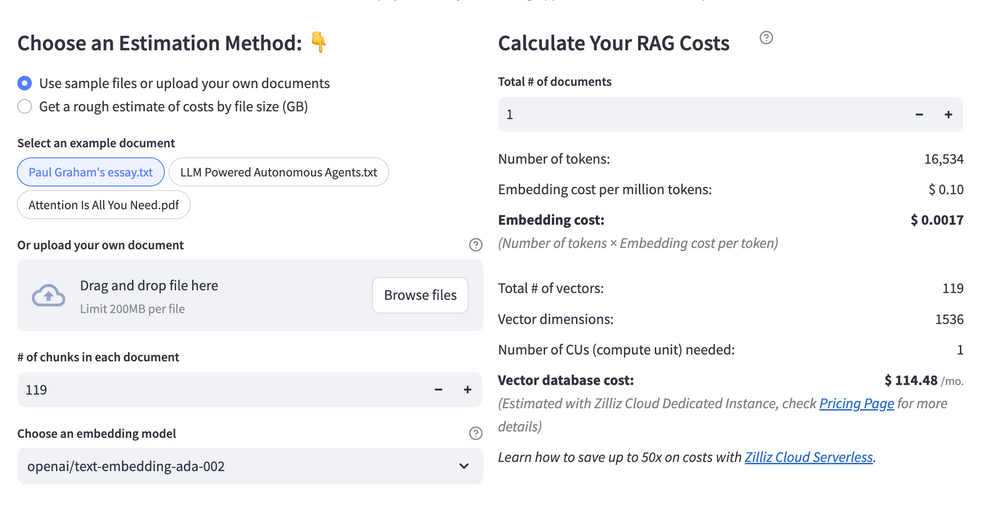
Estimating the cost of a Retrieval-Augmented Generation (RAG) pipeline involves analyzing expenses across vector storage, compute resources, and API usage. Key cost drivers include vector database queries, embedding generation, and LLM inference.
RAG Cost Calculator is a free tool that quickly estimates the cost of building a RAG pipeline, including chunking, embedding, vector storage/search, and LLM generation. It also helps you identify cost-saving opportunities and achieve up to 10x cost reduction on vector databases with the serverless option.
 Calculate your RAG cost
What Have You Learned?
By diving into this tutorial, you’ve unlocked the power of combining cutting-edge tools to build a Retrieval-Augmented Generation (RAG) system from scratch! You learned how Haystack acts as the backbone framework, seamlessly stitching together components like a conductor leading an orchestra. With its intuitive pipelines, you orchestrated the flow of data, queries, and responses, ensuring each part of your RAG system worked in harmony. Then came OpenSearch, your robust vector database, where embeddings transformed raw text into searchable knowledge. By leveraging its lightning-fast retrieval capabilities, you saw how to fetch contextually relevant documents in milliseconds—like having a supercharged librarian at your fingertips. The magic truly sparked when Mistral Nemo stepped in, generating human-like answers by synthesizing retrieved data with its advanced language understanding. Paired with BAAI’s llm-embedder, which converted text into rich numerical representations, you bridged the gap between unstructured data and machine-readable insights, ensuring your system understood nuances and intent with precision.
But this wasn’t just about assembly—it was about optimization and innovation. You discovered practical tips to fine-tune performance, like balancing latency with accuracy or tweaking chunk sizes for better relevance. The free RAG cost calculator gave you a roadmap to budget-friendly scaling, proving that efficiency and affordability can go hand-in-hand. Now, imagine the possibilities: chatbots that answer like experts, search engines that anticipate needs, or tools that democratize access to vast knowledge. You’ve got the blueprint—it’s time to build, experiment, and push boundaries. Whether you’re refining your pipeline, exploring new datasets, or dreaming up entirely novel applications, the future of intelligent systems is in your hands. So fire up your IDE, tweak those parameters, and let your creativity run wild. The world of RAG is waiting for your unique spin—go make it unforgettable! 🚀
Further Resources
🌟 In addition to this RAG tutorial, unleash your full potential with these incredible resources to level up your RAG skills.
- How to Build a Multimodal RAG | Documentation
- How to Enhance the Performance of Your RAG Pipeline
- Graph RAG with Milvus | Documentation
- How to Evaluate RAG Applications - Zilliz Learn
- Generative AI Resource Hub | Zilliz
We'd Love to Hear What You Think!
We’d love to hear your thoughts! 🌟 Leave your questions or comments below or join our vibrant Milvus Discord community to share your experiences, ask questions, or connect with thousands of AI enthusiasts. Your journey matters to us!
If you like this tutorial, show your support by giving our Milvus GitHub repo a star ⭐—it means the world to us and inspires us to keep creating! 💖
- Introduction to RAG
- Key Components We'll Use for This RAG Chatbot
- Step 1: Install and Set Up Haystack
- Step 2: Install and Set Up Mistral Nemo
- Step 3: Install and Set Up BAAI llm-embedder
- Step 4: Install and Set Up OpenSearch
- Step 5: Build a RAG Chatbot
- Optimization Tips
- RAG Cost Calculator: A Free Tool to Calculate Your Cost in Seconds
- What Have You Learned?
- Further Resources
- We'd Love to Hear What You Think!
Content
Vector Database at Scale
Zilliz Cloud is a fully-managed vector database built for scale, perfect for your RAG apps.
Try Zilliz Cloud for Free